
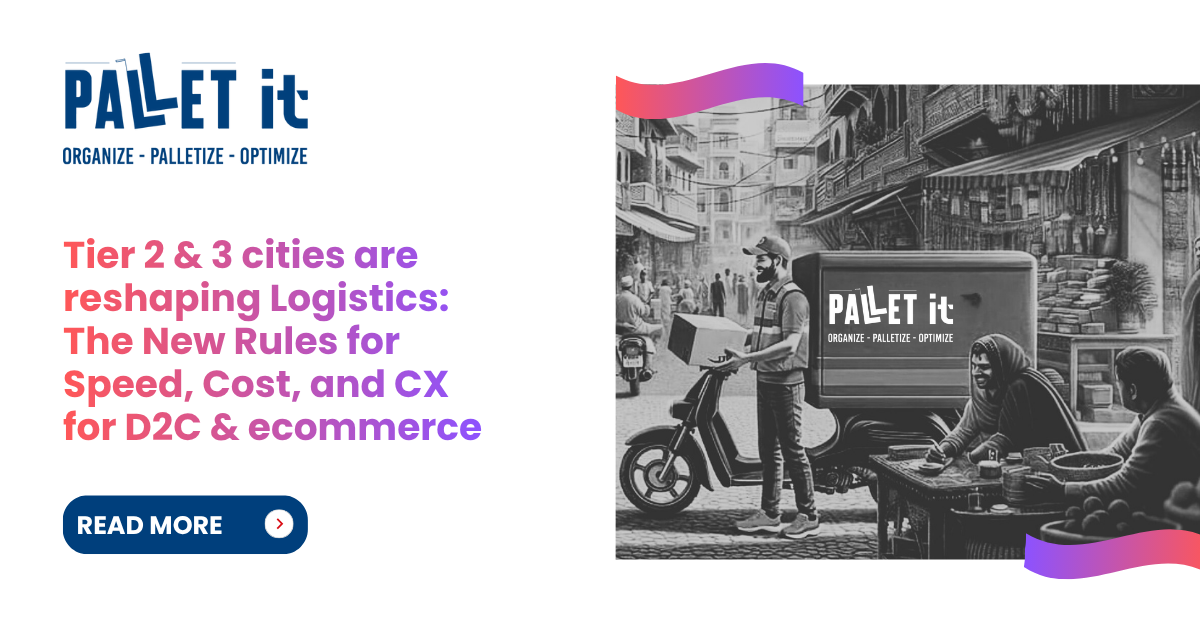
At a D2C & eCommerce meetup in Jaipur last week, two founders; one from a skincare brand and another from a home-decor startup, were complaining about the same issue. Metro deliveries were smooth, but Tier-2/3 orders were draining margins. Rising last-mile costs, unpredictable timelines, RTO spikes, and weak visibility were hitting them hard.
“Whenever demand grows outside metros, our logistics collapses,” one said. The other added, “Tier-3 gives us growth, but also the highest cost-to-serve.”
Their conversation reflects a wider truth: India’s next wave of ecommerce growth is coming from smaller cities, but the logistics backbone hasn’t caught up.
As demand shifts beyond metros, old assumptions; dense pin codes, predictable volumes, strong infrastructure, no longer hold. Tier-2/3 India is now driving acquisition and festive surges, demanding a new playbook for cost, speed, and customer experience.
Why Tier 2/3 India Has Become the New Logistics Battleground for D2C & ecommerce
- Approximately 91% of India’s ecommerce shipments are domestic, and the fastest-growing share comes from Tier 2/3 demand.
- Festive 2024 and 2025 surges were significantly powered by Tier-3 shoppers, especially in fashion, beauty, home & kitchen, and electronics accessories.
The Hidden Cost Problem in Emerging India for D2C & ecommerce
Last-mile is still the biggest cost sink
- Dispersed demand clusters
- Low delivery density
- Longer travel radiuses
- Fuel inefficiency
- Non-standard addresses
Delivery failures worsen the economics.
- Global average: 5% failed deliveries
- India’s Tier-2/3: often significantly higher
Returns and RTO: The Silent Profit Killers
In India, the number is often higher for categories like:
- Apparel
- Beauty
- Footwear
- Electronics accessories
- Unverified or vague addresses
- Limited delivery confidence
- Heavy reliance on COD
- Customer communication gaps
- Weather-driven unpredictability
Infrastructure Gaps Where D2C & ecommerce Supply Chains Break
1. Warehousing imbalance
- Slow replenishment
- Limited assortment availability
- Higher damages
- Expensive same/next-day delivery
2. Fragmented networks
Long-tail SKUs suffer the most due to inconsistent pooling or consolidation.
Visibility and Data Fragmentation: D2C & ecommerce CX Challenge
- Patchy network connectivity
- Inconsistent milestone formats across carriers
- Manual exception management
- Data lag in hub-and-spoke systems
- Unreliable ETAs without congestion intelligence
Platform and Policy Shifts; ONDC, ULIP, NLP, and the Gaps
- ONDC enables multi-carrier access but brings onboarding friction, KYC hurdles, and limited SMB enablement.
- ULIP/NLP promise interoperability, but unified data standards are still maturing.
- Drone/autonomy pilots remain metro-centric.
- Billing disputes
- Weight discrepancies
- Limited evidence standardisation
- Cross-carrier visibility gaps
- Inconsistent dispute frameworks

The New Rules of Tier-2/3 Logistics
Rule #1: Micro Fulfillment Is No Longer Optional
- Micro-fulfillment centers in growing corridors
- Pooled cross-docks
- Dynamic inventory placement
- Cold-chain and bulky SKU micro-nodes
Rule #2: Routing Must Become Rural-Intelligent
Next-gen routing requires:
- Address intelligence
- Landmark-based navigation
- Local-area clustering
- Multi-attempt orchestration
Rule #3: Returns Prevention Must Move Upstream
- Pre-delivery confirmation
- Fit/size prediction
- Doorstep QC
- Fraud scoring
- Courier selection by category
Rule #4: Billing Assurance Must Become Automated
- Weight disputes
- NDR deductions
- Incomplete delivery evidence
Rule #5: SLA Promises Must Match Ground Reality
Logistics must adopt:
- Congestion-aware SLAs
- Surge-aware slotting
- Lane reliability patterns
Rule #6: Unified Event Streams Will Define CX Leadership
- First mile
- Mid-mile
- Last mile
- Returns
How Platforms Like PalletIt Are Closing These Gaps
Brands need orchestration.
✔ Micro-fulfillment + pooled cross-dock networks
✔ Rural-intelligent routing using address intelligence
✔ Automated billing assurance
✔ Predictive ETAs and cross-carrier visibility
✔ Returns-prevention workflows
✔ Congestion-aware promise accuracy
Final Word: Tier-2/3 India Isn’t a Challenge. It’s the New Default.
- Denser micro-fulfillment
- Rural-intelligent routing
- Returns prevention
- Automated billing integrity
- Unified data
- Honest SLAs
- Carrier-agnostic orchestration
It is today’s reality, and the logistics ecosystem must evolve to serve it.